Monday, January 30, 2012

Kids' Thumbprints (TWD)


I'm a horrible blogger :( I haven't posted in weeks... and I made these cookies back in December and I am just now getting around to blogging about it! *sigh* My life is now consumed with play dates, story time, craft time, little gym, etc. so I haven't had nearly as much time as I used to for baking, blogging, and visiting other blogs :( Thank you to those who are still around, reading each blog post that I'm able to put up! I did want to put a question out there to my readers... do you enjoy the posts about food-related coupons and deals? I started with them on my Facebook page, then posted a few here on the blog... but wasn't sure if that was something that people were interested in? Should I stick with just the recipe posts, or would you like to see deals posted too? Please leave me a comment and let me know! :)

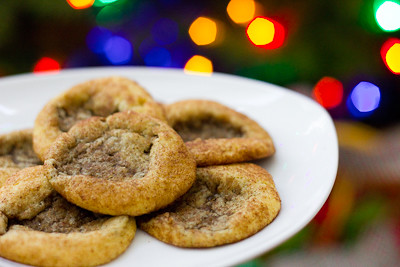
So anyway, without further ado... the very last Tuesdays with Dorie (TWD) recipe was chosen by none other than Dorie Greenspan herself, author of Baking: From My Home to Yours.  She chose Kids' Thumbprints.  These were kind of like grown up peanut butter and jelly cookies.  You take a peanut butter cookie dough and rough it into a ball, then dip it in egg whites and roll it in some chopped up peanuts.  Then proceed like you would with any other thumbprint cookie recipe and press your thumb gently into the center and fill with jam after the cookies have baked.

I only needed one egg white for my cookies, otherwise I followed the recipe exactly as written.  These were incredibly addicting cookies! I found that if you let the jam cool just a little bit after warming it up, the cookies are a little bit easier to fill because then the jam isn't quite so runny.  I shared these with my neighbor and she loved them, too.

If you would like the recipe, you can find here.  This is the last blog post for Tuesdays with Dorie - Baking: From My Home to Yours. I can't believe that after 4 years, we've finally baked through the entire book! It's been so much fun... not only baking everything, but meeting so many other wonderful bloggers out there.  I've had a blast and I have learned so much with the group baking week by week through the book.  I'm still not the best cake decorator out there, but I can make some pretty good pastries and brioche now! I'm so proud of what I have done with the group.  While we are putting Baking back up on the shelf, our group is getting ready to embark on another adventure... as we bake our way through Baking with Julia.  So, if you are interested in baking along with us, please join us as Tuesdays with Dorie: Baking with Julia starts on February 7th!

Saturday, January 7, 2012

Pfaltzgraff Dollar Sale

Pfaltzgraff.com is currently having a Dollar Sale with over 1,200 items on sale for up to 96% off!
They sell high quality dinnerware and kitchenware. Stock up your kitchen with measuring spoons, spatulas, wine openers, pastry brushes and more.  Flat rate shipping is $7.95.  They also have a $5/$10/$20 item sale, too, so be sure to check it out.

Wednesday, January 4, 2012

Nutiva Organic Extra Virgin Coconut Oil 15 oz (2 pack) for $12.16 shipped!


Right now at Amazon the 2 packs of Nutiva Organic Extra Virgin Coconut Oil are $16.20 (down from $24.06).  Choose Subscribe and Save (right side) to get an additional 15% off AND you can use coupon code NUTIVJAN to get another 10% off!  Your total will be $12.16 shipped, or only $6.08 for each 15 oz tub! After your order ships, you can cancel your subscribe & save subscription at no cost.

The reviews on this coconut oil are all very positive too.  If you've never used coconut oil, it is delicious and a healthy alternative to cook with :) No refrigeration is required.  You can use it as cooking oil, a butter substitute, a shortening substitute in baking, or even as massage/body oil!

* Please note that prices do fluctuate often on Amazon so it may not be at this price for long.

Tuesday, December 27, 2011

French Country Bread (DB)


Our Daring Bakers' Host for December 2011 was Jessica of My Recipe Project and she showed us how fun it is to create Sour Dough bread in our own kitchens! She provided us with Sour Dough recipes from Bread Matters by Andrew Whitley as well as delicious recipes to use our Sour Dough bread in from Tonia George’s Things on Toast and Canteen’s Great British Food!

Sourdough is made without adding any yeast or leavening, by fermenting your own sourdough ‘starter’. The natural yeasts in the flour do the work of making a lovely loaf of bread – we just facilitate that process. Sourdough is basically bread as your great-, great- grandmother knew it, before the days of Chorleywood (i.e. factory-made, steamed, sliced, additive-filled) bread and packaged yeast. It takes time, but not too much active work. 

I have to say that while I had a lot of fun with this recipe, it was a colossal fail!  I've never made a starter before, and watching this one develop and bubble up was really cool.  Unfortunately, I let my dough proof too long (didn't realize that would be an issue), and while I ended up with what looks like a beautiful loaf, it was extremely dense and didn't quite develop the crumb I was hoping it would.  I was hoping to get a good picture of the cut loaf, but since I failed to successfully get a good crumb, I didn't photograph the inside of the loaf :(

The great thing about this recipe, though, is that you're left with a starter that you can keep on using... so I look forward to trying this recipe again! :) Thanks Jessica, for hosting this month's challenge.  Make sure you check out the Daring Bakers' Blogroll to see how everyone else rose to the challenge.

French Country Bread
Servings: 1 large loaf plus extra wheat starter for further baking
Wheat Starter - Day 1:

Ingredients
4 1/2 tablespoons (70 ml) (40 gm/1 ½ oz) stoneground breadmaking whole-wheat or graham flour
3 tablespoons (45 ml) water
Total scant ½ cup (115 ml) (3 oz/85 gm)

Directions:
1. In a Tupperware or plastic container, mix the flour and water into a paste.
2. Set the lid on top gently, cover with a plastic bag, to prevent messes in case it grows more than expected!
3. Set somewhere warm (around 86 F if possible). I sometimes put mine on a windowsill near a radiator, but even if it’s not that warm, you’ll still get a starter going – it might just take longer.

Wheat Starter - Day 2:


Ingredients
4 1/2 tablespoons (70 ml) (40 gm/1 ½ oz) stoneground breadmaking whole-wheat or graham flour
3 tablespoons (45 ml) water
scant 1/2 cup (115 ml) (3 oz/85 gm) starter from Day 1
Total scant cup (230 ml) (6 oz/170 gm)

Directions:
1. Stir the flour and water into the mixture from Day 1, cover, and return to its warm place.
Wheat Starter - Day 3:

Ingredients
4 1/2 tablespoons (70 ml) (40 gm/1 ½ oz) stoneground breadmaking whole-wheat or graham flour
4 teaspoons (20 ml) water
scant 1 cup (230 ml) (6 oz/170 gm) starter from Day 2
Total 1⅓ cup (320 ml) (230 gm/8-1/10 oz)

Directions:
1. Stir the flour and water into the mixture from Day 2, cover, and return to its warm place.
Wheat Starter - Day 4:

Ingredients
3/4 cup plus 1½ tablespoons (205 ml) (120 gm/4 ¼ oz) unbleached all-purpose flour
1/2 cup less 4 teaspoons (100 ml) water
1⅓ cup (320 ml) (230 gm/8 oz) starter from Day 3
Total scant 2⅔ cup (625 ml) (440 gm/15½ oz)

Directions:
1. Stir the flour and water into the mixture from Day 3, cover, and return to its warm place. At this point it should be bubbling and smell yeasty. If not, repeat this process for a further day or so until it is!

French Country Bread
Stage 1: Refreshing the leaven

Ingredients
1 cup less 1 tablespoon (225 ml) (160 gm/5 ⅔ oz) wheat Leaven Starter
6 tablespoons less 1 teaspoon (85 ml) (50 gm/1¾ oz) stoneground bread making whole-wheat or graham flour
1 cup plus 2 teaspoons (250 ml) (150 gm/5 ⅓ oz) unbleached all purpose flour
1/2 cup (120 ml) water
Production Leaven Total 2¾ cups plus 4 teaspoons (680 ml) (480 gm /1 lb 1 oz)

Directions:
1. Mix everything into a sloppy dough. It may be fairly stiff at this stage. Cover and set aside for 4 hours, until bubbling and expanded slightly.

French Country Bread
Stage 2: Making the final dough

Ingredients
3/4 cup less 1 teaspoon (175 ml) (100 gm/3 ½ oz) stoneground breadmaking whole-wheat or graham flour, plus more for dusting
2 cups plus 2 tablespoons (510 ml) (300gm/10 ½ oz) unbleached all-purpose flour
1¼ teaspoons (7½ ml) (7 gm/¼ oz) sea salt or ⅔ teaspoon (3⅓ ml) (3 gm/⅛ oz) table salt
1 ¼ cups (300 ml) water
1 ¾ cups (425 ml) (300 gm/10 ½ oz) production leaven – this should leave some (1 cup) for your next loaf.
Total 6 cups less 2 tablespoons 1415 ml (1007 gm/35 ½ oz/2 lb 3½ oz)

Directions:
1. Mix the dough with all the ingredients except the production leaven. It will be a soft dough.
2. Knead on an UNFLOURED surface for about 8-10 minutes, getting the tips of your fingers wet if you need to. You can use dough scrapers to stretch and fold the dough at this stage, or air knead if you prefer. Basically, you want to stretch the dough and fold it over itself repeatedly until you have a smoother, more elastic dough.
See my demonstration here: http://www.youtube.com/watch?v=OqS3raEGdwk
3. Smooth your dough into a circle, then scoop your production leaven into the centre. You want to fold the edges of the dough up to incorporate the leaven, but this might be a messy process. Knead for a couple minutes until the leaven is fully incorporated in the dough. See my demonstration here: http://www.youtube.com/watch?v=UPO97R4iO4U
4. Spread some water on a clean bit of your work surface and lay the dough on top. Cover with an upturned bowl, lining the rim of the bowl with a bit of water. Leave for an hour, so that the gluten can develop and the yeasts can begin to aerate the dough.
5. Once your dough has rested, you can begin to stretch and fold it. Using wet hands and a dough scraper, stretch the dough away from you as far as you can without breaking it and fold it back in on itself. Repeat this in each direction, to the right, towards you, and to the left. This will help create a more ‘vertical’ dough, ready for proofing. See my demonstration here: http://www.youtube.com/watch?v=rDoJRCMfclE
6. Heavily flour a banneton/proofing basket with whole wheat flour and rest your dough, seam side up, in the basket. Put the basket in a large plastic bag, inflate it, and seal it. Set aside somewhere warm for 3-5 hours, or until it has expanded a fair bit. It is ready to bake when the dough responds to a gently poke by slowly pressing back to shape.
7. Preheat the oven to hot 425°F/220°C/gas mark 7. Line a baking sheet with parchment, then carefully invert the dough onto the sheet. I like to put the baking sheet on top of the basket, then gently flip it over so as to disturb the dough as little as possible. Make 2-3 cuts on top of the loaf and bake for 40-50 minutes, reducing the temperature to moderately hot 400°F/200°C/gas mark 6 after 10 minutes.
8. Cool on a cooling rack.

Notes:
• Good bread starts with good flour. Beyond trying to find good quality, local (organic if possible) flour, Whitley recommends finding out three things: how was it milled? (stoneground ideally, to retain more nutrients); how much of the original grain is left in the flour (ideally 95-100 % for bread making); and lastly, how much protein is in the flour? (the more protein, the more gluten, leading to a more stretchy dough – ‘strong’ or ‘bread’ flour indicates a higher level of protein).
• Normal tap water is fine in most cases, unless you live in a municipality that heavily chlorinates the water. Chlorine will kill almost all bacteria, including your yeast, so you’ll want to use filtered water if you can. Whitley says that leaving water in a pitcher overnight can rid most of the chlorine.
• If you clean your kitchen with anti-bacterial products or harsh cleaners, try not to do it before baking and make sure your bowls are clean but have no chemical residue left on them! Many a bread has been deflated by an overly-sterilised kitchen.
• All of these recipes call for sea salt because it retains a higher level of minerals and has a stronger salt taste, meaning you can use less of it. Never add salt directly to your starter – it will kill the yeast, so use the following method: dissolve your starter in water, stir your salt through your flour, then mix the wet with the dry ingredients.
• When greasing pans for baking, try to use hard fats like butter because oil can drip down the pans and lead to a fried bottom on your loaf!
• When working with the dough, you might feel inclined to heavily flour your work surface or your hands. Resist this urge! Sourdough is meant to be wet and sticky – this helps to give the bread a nice crumb once it has baked. I work most doughs with my hands, but sometimes use a dough scraper to help lift and fold the dough. When I need to pick up or shape a loaf, I find damp hands work better than floured ones!
• If you don’t have dough scrapers, old bank cards/credit cards work just as well! But wash them thoroughly first.
• Try to work with your hands to make these recipes – mixing and kneading the dough by hand means you’ll get a better sense of how your dough should feel! We learn by doing!
• Remember, a lot of these timings are guidelines – pay attention as, depending on temperature and your starter, you may need more or less time to proof your dough. You want a dough that resists poking a bit (if you poke it, the hole will disappear) but not one that quivers all over and seems really fragile.
• Cutting the top of your loaf before it goes in the oven helps it to expand or split at those points. This means you don’t end up with funny outgrowths from your bread! You want to be quick, gentle, and use a very sharp blade – see the video at the end for tips.
• Notes on scheduling: For the Rye loaf, and all the other starters, I find it helpful to start the process on a Monday, so that come Friday/Saturday you are ready to bake. I refresh my starter (Stage 1) the night before baking, then do Stage 2 in the morning. For the French Country Bread, I refresh the starter in the morning, make the final dough at lunchtime, and bake at dinner time. For the Rice Sourdough, I soak the flaxseeds on a Friday morning, refresh my starter on Saturday morning, the prep the final dough at lunchtime, ready to bake at dinner.
• I would set the difficulty level of these recipes as: Rye – Easy!, French Country Bread – Med-Hard!, Rice Sourdough – Easy!
• Once you’ve finished baking, you’ll have some leftover starter. Keep this in a Tupperware container, as this is what you will use to start your next loaf (and so on…)! Some of the best starters are hundreds of years old – and they get better with time. If you bake daily, you can keep your starter at room temperature. If you bake weekly, I’d keep it in the fridge. You can also freeze starter if you bake very infrequently, but I find it does fine in the fridge so long as you feed it at least once a month. Simply refresh your starter according to the recipe – or with equal parts by weight of flour and water – and let it come back to life at room temperature.
• You might notice that your starter starts to smell a bit like acetone – this is completely normal. It may develop a grey liquid on top, which you can either pour off or stir back into the starter. When I refresh mine, I discard half of the original starter and add in fresh flour and water for the yeast to feed on.
• Sometimes, very rarely, a starter might get moldy. This is often due to being left at room temperature without feeding. If there is a lot of mold throughout the starter, I would discard it. But the odd bit is not always a problem. It is nearly impossible to kill a starter, unless you get salt or chemical products in it – so don’t fret! Often it is just a matter of feeding it over a few days and nursing it back to life.

Sunday, December 25, 2011

Merry Christmas!


I hope everyone has had a sweet holiday with their family and friends.  We've certainly enjoyed visiting with our family and celebrating Christmas with our precious little 2 year old.  She had lots of fun opening presents (hers and everyone elses!) while exclaiming, "rip it!" as she tore through all the wrapping paper :)  I can only imagine how next year will be even more fun!

And, for those who entered the Peeled Snacks giveaway, I'm happy to announce that Denise L. is the winner.  I have emailed Denise and if I do not receive a reply within 48 hours, I will choose an alternate winner.  Congrats Denise, and Merry Christmas!

Monday, December 19, 2011

$0.99 Brie

Right now at Target, you'll find President Brie Cheese (8 oz) for $3.49.  Use the $2.50 off coupon found here (you’ll need to share this offer with 3 friends) and get it for just $0.99!

If you're doing any holiday entertaining this year, this delicious Baked Brie is sure to please all your guests! :)

Tuesday, December 13, 2011

Unbelievably Good Chocolate Blueberry Pomegranate Ice Cream (TWD)


This week's Tuesdays with Dorie (TWD) recipe was chosen by Laurie (founder of TWD!) of Slush: Unbelievably Good Chocolate Blueberry Ice Cream.

I would never to think to make chocolate blueberry ice cream, but I've totally had chocolate covered strawberries, and chocolate covered dried cherries, blueberries, etc. so of course it would make sense that chocolate blueberry ice cream would be good :)

I thought I had everything I needed for this recipe because we usually keep frozen blueberries on hand for my daughter, but when I went to the make the recipe I realized that the recipe calls for blueberry preserves, not fresh/frozen blueberries! Well, I just so happened to receive some Pomegranate Jelly for my birthday in November, so I decided to puree some frozen blueberries (about 1 tbsp) and mixed it together with the Pomegranate Jelly.... resulting in the most delicious chocolate blueberry pomegranate ice cream!

If you would like the recipe, you can find here.  Make sure you also check out this page, too, so you can see what everyone else thought of this unusual chocolate ice cream!

And if you haven't already, don't forget to enter my Peeled Snacks Giveaway!